
An esports tournament is a structured competitive gaming event where players or teams compete under standardized rules for prize money, ranking points, or prestige. Running a tournament requires coordinating game server infrastructure, broadcasting hardware, player registration systems, and publisher licensing agreements into a single synchronized operation.
The project of running a tournament involves far more than simply launching a video game. It requires a dedicated staff managing a complex technical stack that records player statistics, enforces competitive fairness, and streams high-definition video to thousands of concurrent viewers. Modern organizers increasingly rely on advanced data platforms like Lexogrine HUD Manager to automate this visual data flow and reduce production bottlenecks. For brands, these events solve the problem of reaching a highly engaged, digitally native demographic by providing a predictable marketing environment. For gaming communities, tournaments provide a defined schedule, clear dispute resolution protocols, and a centralized stage for high-level play. As the global gaming audience reaches 3.6 billion in 2026, structured tournaments act as the main vehicle for converting casual players into dedicated fans.
Why structure matters in competitive gaming
Organizing a competitive event requires strict rules and technical boundaries. Casual gaming relies on matchmaking algorithms to pair players randomly in low-stakes environments. Professional organized competition requires brackets, seeds, and strict scheduling to determine a single undisputed winner.
Here is why. Players require absolute competitive fairness. If a network drop happens during a match, a formal structure dictates whether the round restarts, the match pauses, or the disconnected player forfeits. Without clear rules, organizers face constant disputes. These disputes cause broadcast delays. Broadcast delays damage viewership and sponsor visibility.
Structure solves three main practical problems in competitive gaming:
- Schedule management: A 64-team bracket cannot function on verbal agreements. Organizer needs to keep track of match times, enforce check-in deadlines, and penalize late arrivals.
- Player disputes: A published rulebook dictates exact server settings, allowed weapon skins, and permitted tactical pauses. Referees point to the rulebook to resolve conflicts instantly and maintain the flow of the broadcast.
- Sponsor visibility: Brands pay for on-screen logo placement during live matches. If a tournament runs three hours late due to unorganized check-ins, the broadcast loses peak viewership, and sponsors lose money.
Establishing a formal structure transforms a casual gathering into a commercial product. It provides the exact framework needed to attract professional teams, secure corporate sponsorships, and deliver a reliable broadcast to thousands of viewers.
Planning the foundation
Every tournament begins with game selection, licensing, and financial planning. Organizers cannot host a professional event without written permission from the game publisher.
First, organizers must select the game. The game choice dictates the target audience, the necessary hardware, and the legal requirements. Once the game is chosen, the organizer must secure the correct publisher license. Publisher licenses dictate maximum prize pools, allowed sponsors, and broadcast rights.
Understanding publisher licenses in 2026
Game publishers own the intellectual property. Organizers must obey their specific legal frameworks to avoid lawsuits or event cancellations.
Valve (Counter-Strike 2 and Dota 2) Valve separates licenses into Community, Tier 2, and Tier 1 categories. Community licenses prohibit organizers from using terms like "official" or "authorized". They also forbid sponsorships from companies dealing in crypto, gambling, or game key reselling. For higher-tier events, the requirements scale up heavily. Tier 1 events starting after December 31, 2026, require the organizer to announce the tournament 22 months in advance. Tier 1 events must invite a minimum of 20 rosters directly from the official Valve Regional Standings (VRS) list. The Main Stage must feature a minimum of 8 rosters. Tier 2 events require an announcement at least three months before the start of the main event. Valve has completely stopped issuing tournament licenses for the legacy title CS:GO, forcing all organizers to use CS2.
Riot Games (Valorant and League of Legends) Riot Games uses a structured partnership and application model. For the 2026 season, Riot opened a one-month application window for prospective organizers. For Valorant, applications opened from August 3 to August 28, 2026. For League of Legends, the window opened from September 1 to September 30, 2026. Riot heavily regulates third-party events to protect its primary franchise leagues like the Valorant Champions Tour (VCT) and the League of Legends Championship Series (LCS). Regional dominance remains a central focus, with major US cities acting as hubs for large-scale finals.
Epic Games (Fortnite) Epic Games enforces strict financial caps on third-party tournaments. The total compensation paid to all players across a single event cannot exceed $25,000 USD. Furthermore, sponsor contributions cannot exceed $25,000 USD. Organizers cannot use player data or match results for fantasy sports betting. To host private matches, organizers must email a formal request to Epic Games detailing the event date, prize pool, and creative branding. Epic Games explicitly notes that third-party tournaments do not receive access to official spectator tools or automated scoring systems.
Technical Setup and Infrastructure
The technical stack forms the backbone of the tournament. If the game servers fail, the tournament stops. If the management software crashes, the schedule falls apart. Organizers must build a secure, high-speed digital environment.
Game servers and network delay management
Competitive gaming requires absolute precision. A network delay of just 30 milliseconds dictates whether a player wins or loses a match. To provide a smooth experience, organizers rely on localized, high-speed dedicated servers.
We must define the term "tick rate." Tick rate refers to the frequency at which a server processes updates. High-tier competitive matches operate on 128-tick servers. This means the server calculates game physics, bullet trajectories, and player positions 128 times every single second. Hong Kong and other major global data hubs provide colocation services equipped with cross-border data transmission lines. These hubs keep ping strictly below 40 milliseconds for regional players.
Anti-cheat systems
Protecting the integrity of the match requires deep system-level software. Cheating in 2026 involves advanced hardware exploits. Modern cheats use Direct Memory Access (DMA) devices. These physical cards plug directly into a computer's PCIe slot. They read system memory without interacting with the CPU, making traditional software detection useless.
To stop DMA cheats, Riot Games updated its Vanguard anti-cheat software to enforce strict hardware checks during the system boot sequence. When a computer turns on, it executes its initial firmware (UEFI), granting unrestricted access to all connected hardware before the operating system loads. Vanguard forces the motherboard to enable the Input-Output Memory Management Unit (IOMMU). IOMMU bridges the gap between hardware components and the operating system, blocking unauthorized PCIe devices from reading the game's memory space. Server-side anti-cheat frameworks also use machine learning to detect unnatural mouse movements and superhuman reaction times, providing a secondary layer of defense.
Tournament management software
Managing a 64-team bracket manually using spreadsheets guarantees errors. Organizers use dedicated web platforms to handle brackets, scores, and player check-ins.
These platforms automate the heavy lifting. Teams register online, pay their entry fees, and submit their rosters through the platform. Once registration closes, the software algorithmically generates the brackets, assigns seeds based on past performance, and generates match times. Players use the platform to "check in" before a match begins.
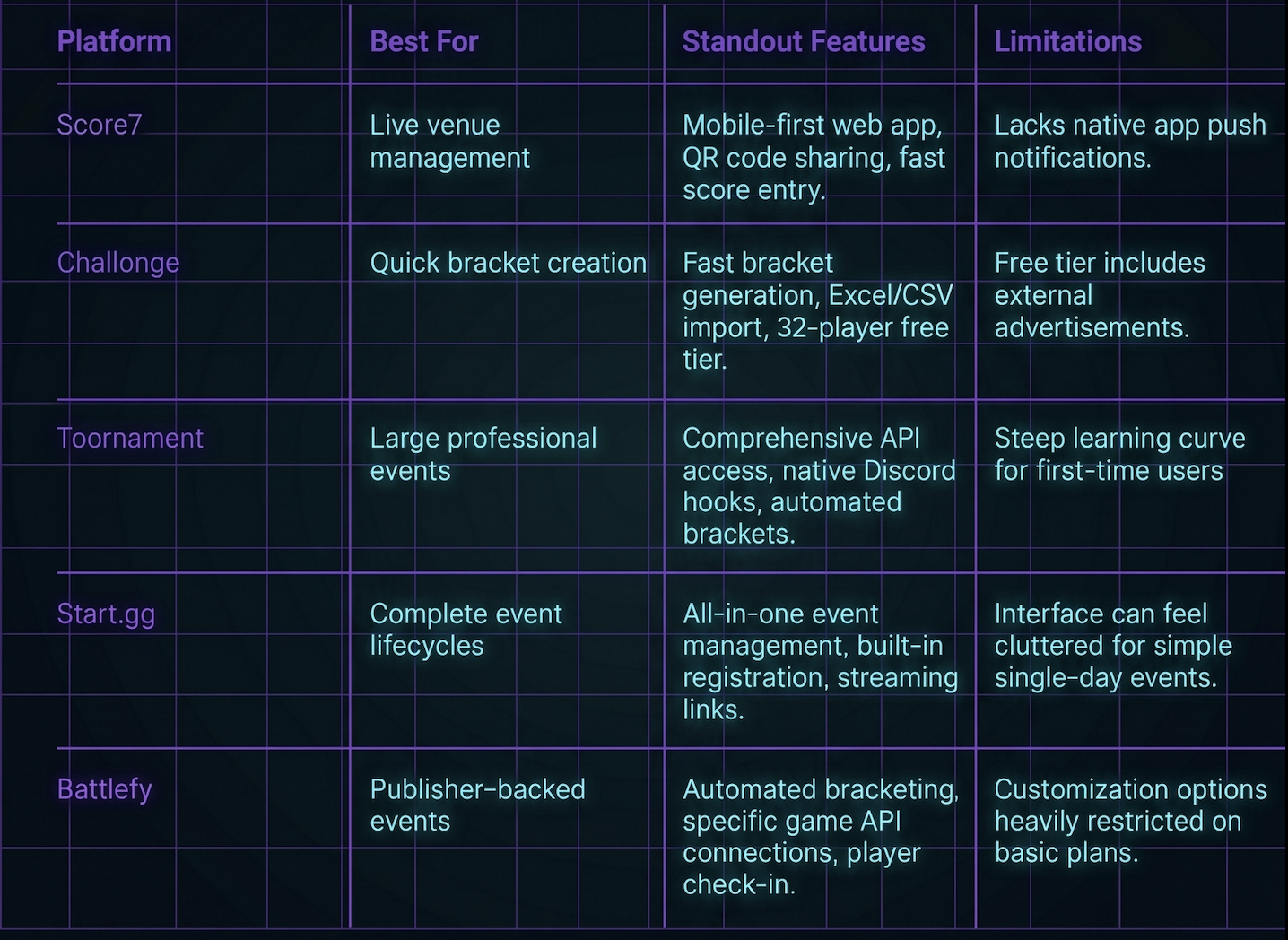
When a match ends, data must move quickly. While traditional setups require players to upload screenshots of the scoreboard, modern productions utilizing Lexogrine HUD Manager can pull the final match data directly from the server API, streamlining result reporting and updating the broadcast instantly.
The Broadcast Stack (Production)
The broadcast stack turns raw gameplay into an entertainment product. It combines video switching, in-game observing, statistical overlays, and commentary into a single video feed sent to streaming platforms like Twitch or YouTube.
Video mixing
Productions rely on software vision mixers like vMix or OBS Studio. These programs ingest multiple video and audio feeds, allowing a technical director to switch between player cameras, the game screen, and the commentators.
A 4K 60fps broadcast demands immense hardware power. Standard laptops cannot handle the encoding requirements. Here is the hardware requirement for a professional 2026 broadcast machine running vMix for high-end production:
Because specialized tools like Lexogrine HUD Manager output graphics as lightweight, browser-based sources, technical directors can layer professional 4K data overlays directly into vMix without excessively taxing the GPU. This eliminates the need for expensive, dedicated character generator (CG) rendering machines.
The role of observers
Observers act as the in-game camera operators. We define an "observer" as a trained professional who controls the spectator view inside the game client. They choose which player to follow and when to show a wide aerial view of the map. Good observing requires deep game knowledge to predict where the next fight will happen.
However, relying entirely on human observers is expensive and prone to fatigue. LHM’s Scout AI feature solves this by acting as an automated, intelligent observer. By reading game data in real-time, Scout AI algorithmically predicts action, switches camera angles without human input, and guarantees that the broadcast never misses a crucial elimination.
Live HUDs and data overlays
Viewers need constant context. They need to see player health, ammunition, map positions, and current scores. Games like CS2 provide this data through a mechanism called Game State Integration (GSI).
Here is how it works. We define an "API hook" as a method that allows one piece of software to intercept data from another. GSI acts as a continuous API hook. The organizer places a configuration file named gamestate_integration_custom.cfg inside the game directory. This file instructs the game client to send live data payloads formatted in JSON to a specific local HTTP endpoint.
Production teams use specialized platforms like LHM.gg to process this incoming data. LHM acts as the brain of the broadcast overlay. It receives the raw JSON GSI payloads and translates them into polished, professional broadcast graphics.
Beyond basic health and score bars, LHM automates heavy portions of the production:
- Scout AI: An AI-driven observer for CS2 that handles intelligent camera switching and event detection. It analyzes the game state in real-time to ensure the broadcast never misses a kill.
- LHM Replays: A seamless, automated system for high-quality instant replays. It automatically logs key game events and manages video data storage. This allows technical directors to trigger instant replays with one click, eliminating the need for manual clipping or moving files between production machines.
- HUD Composer: A visual, drag-and-drop editor that allows tournament organizers to design and customize their own CS2 HUDs from scratch. It provides a real-time preview and full control over brand elements, colors, and layout, enabling a unique visual identity for every event without writing a single line of code.
- Data Management: Lexogrine HUD Manager allows user to store and manage data like teams, players, matches or tournaments setup. To name a few examples, with LHM users can update team names, logos, player photos. series scores, tournament brackets or active map veto picks in real-time. It ensures that the broadcast overlay is always synchronized with the tournament's progress, allowing for quick adjustments before and during the live stream.
Casting and talent management
Casters provide the vocal narrative. Play-by-play casters react to the immediate action, speaking quickly during intense moments. Color commentators provide deep analytical breakdowns during quiet periods. Organizers position the casting desk in front of physical cameras and route their broadcast headsets through XLR audio interfaces directly into the vMix system. Proper talent management involves supplying casters with detailed statistical dossiers. By utilizing LHM's data-gathering capabilities, producers can feed real-time, highly accurate player statistics to the casting desk monitors, allowing commentators to craft compelling, data-driven storylines mid-match.
Marketing and Sponsorships
Tournaments cost money. Organizers recoup these costs through ticket sales, entry fees, and corporate sponsorships. Sponsors pay for access to the highly targeted demographic of young, digitally native gamers.
Creating a brand for the tournament
A tournament needs a strong visual identity. Organizers commission custom logos, animated broadcast transitions, and physical stage designs. This branding packages the event as a premium product. Premium products justify high sponsorship asking prices.
Finding sponsors and dynamic asset placement
Sponsors require visibility. Organizers place sponsor logos in three specific areas:
- In-game: Custom map assets or server naming conventions.
- On-stream: Logos placed on the HUD and video commercials played during tactical pauses. Using Lexogrine HUD Manager, organizers can program dynamic sponsor injections. For example, LHM can recognize a specific game state (like an ace or a bomb defuse) and automatically flash an energy drink sponsor's logo across the screen as the "Clutch Moment," maximizing brand impact without requiring a technical director to press a single button.
- Physical venue: Banners, player jerseys, and product demonstration booths.
Financial returns and viewer measurement
In 2026, brands demand exact mathematical proof of their financial return. They no longer accept vague estimates of audience size. Non-endemic brands achieve an average recall rate of 53%, outperforming endemic gaming brands that sit at 43%.
Organizers provide exact data to prove this value. Digital analytics platforms track peak concurrent viewership, average watch time, and chat engagement rates.
Community engagement tactics
Gamification keeps audiences watching during delays. Organizers build proprietary portals featuring daily mission streaks, loyalty points, and interactive leaderboards. Fans earn points by predicting match outcomes or answering trivia questions. These tools boost viewer retention by up to 40%. An engaged audience drives down the customer acquisition cost, keeping it closer to the industry target of $30.
Partnering with Lexogrine
Lexogrine offers a full custom spectator and observer HUD implementation service - design, development, and even custom functionalities. You simply provide us with your requirements and that's it - we take care of everything, constantly presenting you with the progress of the work and consulting you at every stage of creating your custom HUD.
Lexogrine builds custom AI agent systems from scratch, delivering the entire software package rather than just the agent logic. Using a modern delivery stack composed of React, React Native, Node.js, and AWS, Lexogrine engineers full end-to-end business software.