
Lexogrine is launching Conscriba, a new product for making websites easier for AI agents to access, understand, and act on.
As part of the launch, LHM.gg now supports WebMCP through Conscriba. This means the LHM.gg website can expose selected site actions as structured tools for AI agents, rather than relying only on traditional page content and visual browsing.
For LHM.gg, this is a natural step. LHM is built for esports production teams, broadcast operators, HUD creators, tournament organizers, and technical teams that already work with automation, APIs, overlays, and production workflows. WebMCP extends that mindset to how AI agents interact with the LHM.gg website itself, giving teams more ways to automate LHM usage.
For SaaS products and web applications in 2026, an agent-friendly website is becoming a practical product and marketing layer. More people are asking AI systems to compare products, check pricing, find documentation, contact vendors, or prepare purchasing research. If a website can describe its actions in a structured way, agents can work with it more directly. It was crucial to us to make the LHM.gg platform accessible for AI agents, giving our users even more ways to interact with the whole ecosystem.
And yes, we are experimenting with agentic usage of the LHM desktop application.
What WebMCP is and what it changes
WebMCP is an emerging standard proposed by Google for exposing website actions to AI agents through defined tools.
Without WebMCP, an AI agent usually has to work with a website in a more indirect way. It may read visible content, parse navigation, follow links, interpret page structure, and infer what actions are possible. That can work for simple reading tasks, but it is not ideal when the agent needs to do something specific.
With WebMCP, a website can define tools that describe available actions in a structured format. An AI agent can then call those tools instead of guessing how to interact with the site.
That can apply to actions such as:
- Searching a website
- Checking product or pricing information
- Finding documentation
- Opening a contact path
- Browsing a product catalog
- Starting a request or lead flow
For SaaS companies and web applications, the main change is actionability. The website is no longer only a set of pages for humans. It can also become a structured set of actions that agents can discover and call.
This does not replace the website, but it adds another access layer for AI systems that may become part of how users research products, compare tools, and start conversations with vendors.
What Conscriba does
Conscriba is Lexogrine’s product for adding, managing, and measuring WebMCP on websites.
The goal is to make WebMCP practical for product and marketing teams. Instead of treating WebMCP as a one-time technical task, Conscriba gives teams a way to scan a website, review suggested tools, publish selected tools, and track how AI agents interact with them.
AI scans for tool discovery
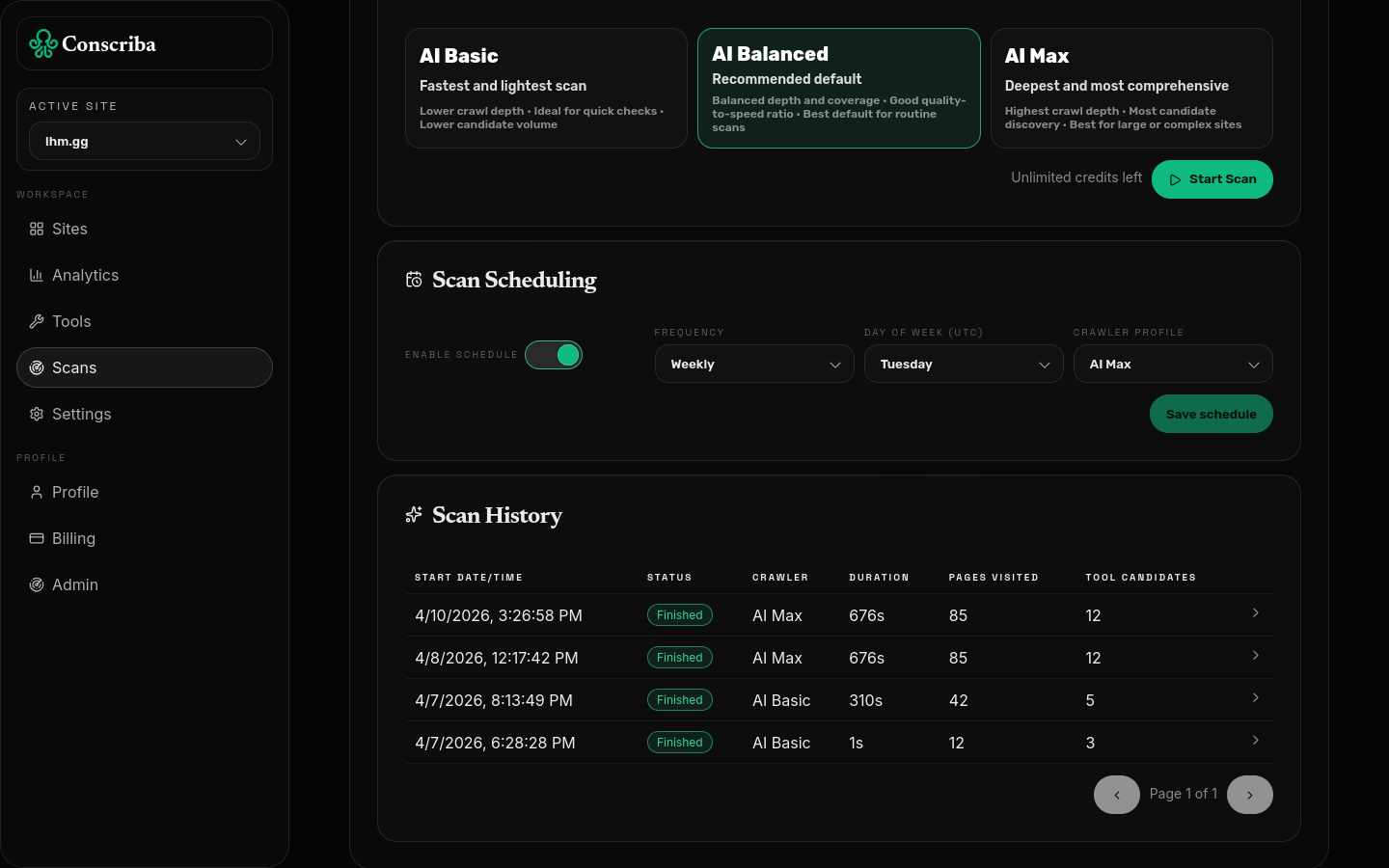
Conscriba can scan a website to detect places where WebMCP tools may make sense. The scan looks for possible site actions, such as search, contact forms, pricing paths, documentation pages, product browsing, or other flows that an AI agent could use directly.
This is where Lexogrine’s work in custom AI agent development is part of the product foundation. Conscriba uses an agent built from scratch to scan websites and identify potential WebMCP tools for tool discovery.
Review and approval flow
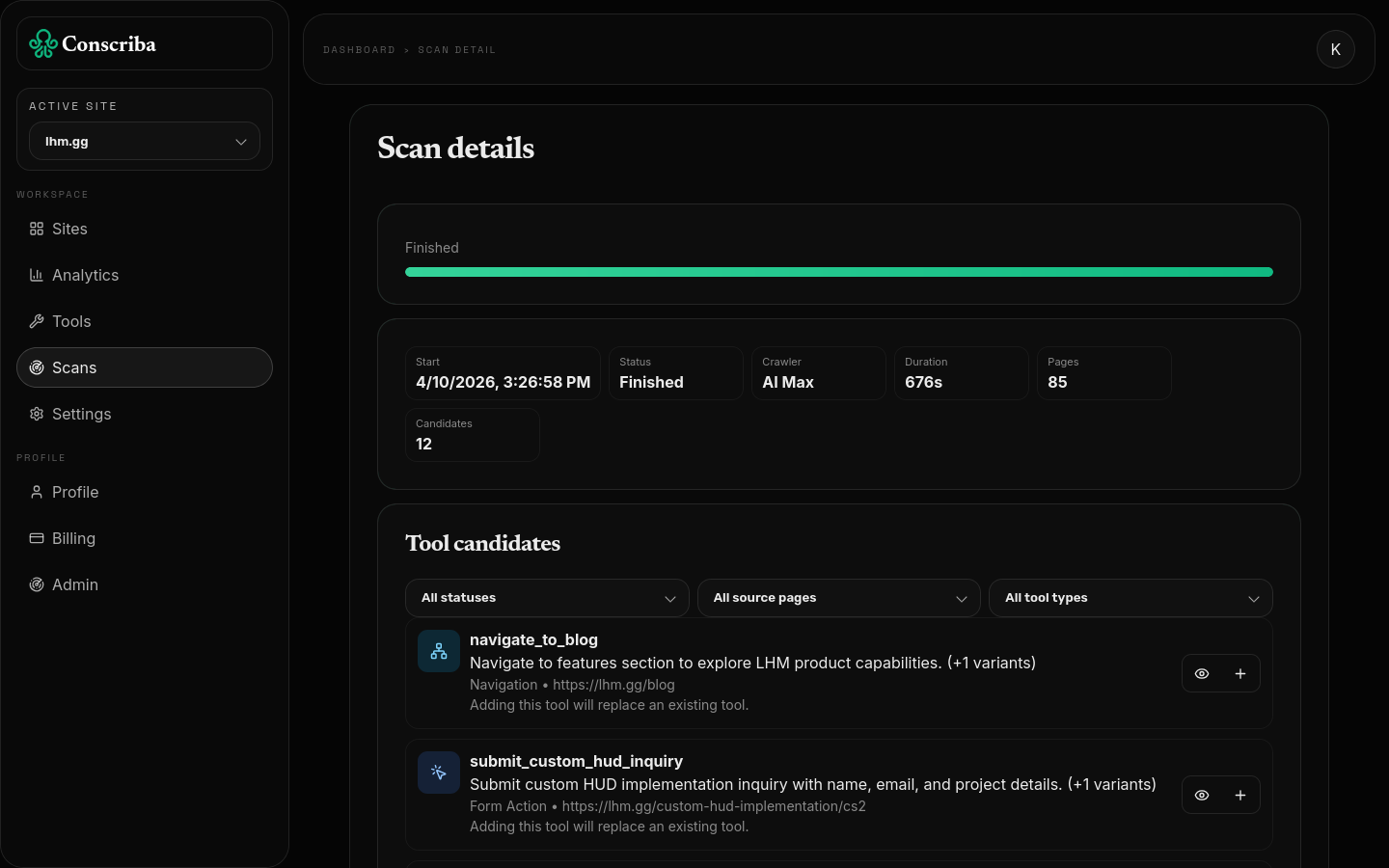
A scan should not publish tools blindly. Conscriba gives teams a review step where proposed tools can be accepted or rejected. This keeps control with the website owner. Product, marketing, and technical teams can decide which actions should be exposed to agents and which should remain unavailable.
This matters for SaaS platforms and web applications, where not every page action should automatically become a public tool.
WebMCP tool generation and publishing
After tools are approved, Conscriba generates and exposes WebMCP tools for the website.
The published tools can describe actions in a way that agents can understand. The exact set of tools depends on the website structure and the owner’s choices.
For a website, common tool types may include site search, pricing navigation, contact actions, documentation navigation, or product information access.
Analytics for tool invocations and usage
Conscriba also tracks how tools are used.
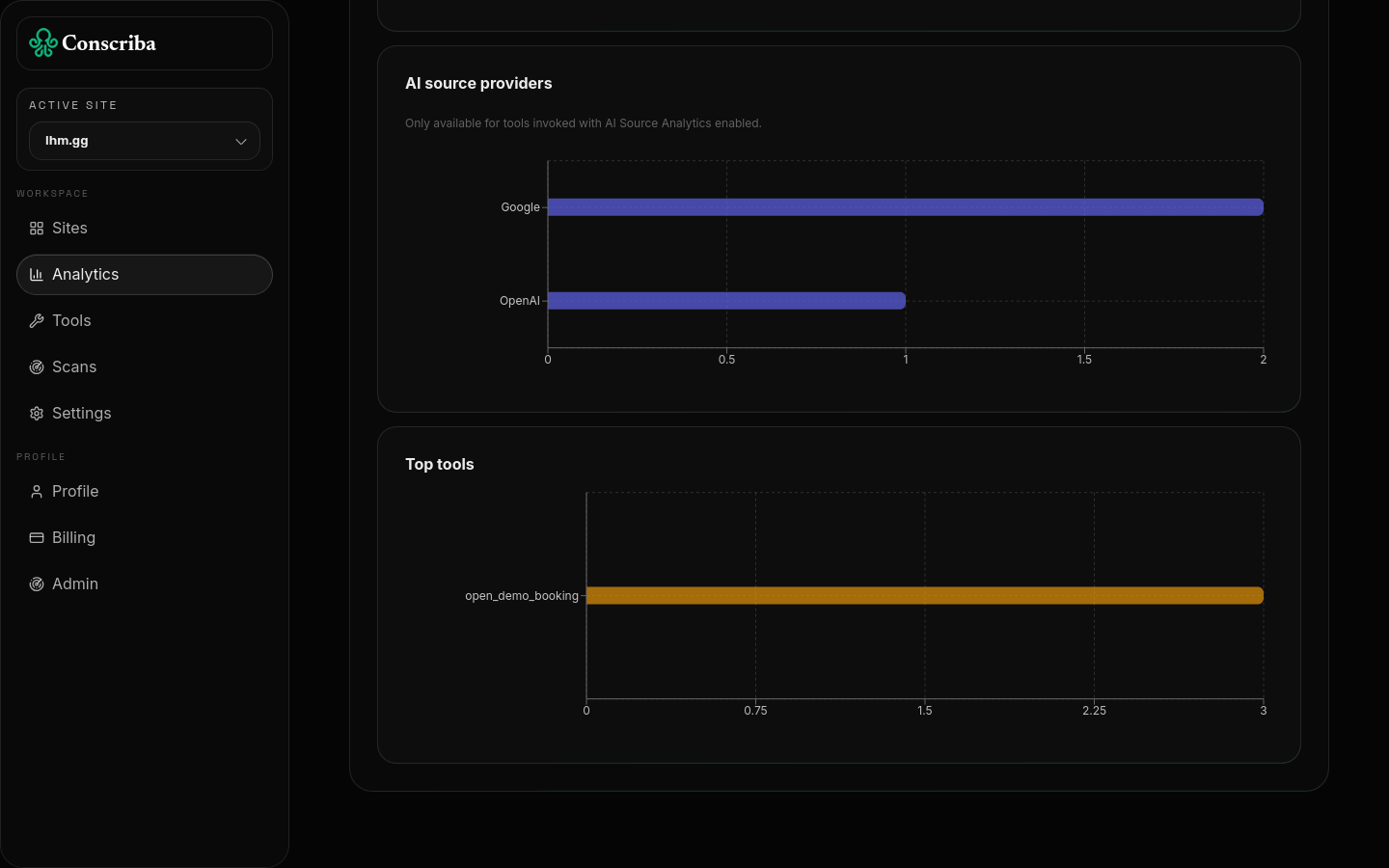
Teams can see tool invocations, usage patterns, and simple metrics around agent activity. This helps answer questions such as:
- Which tools are being called?
- Which actions attract agent interest?
- Are agents using contact or pricing paths?
- Which descriptions may need to be rewritten?
This creates a feedback loop. Instead of guessing how agents interact with a website, teams can review actual usage signals.
Conversion tracking for tool actions
Conscriba can also track conversions at the tool action level. For LHM.gg and other SaaS websites, this can help separate passive agent visits from actions that matter more, such as opening a contact path, reaching pricing information, or navigating toward documentation.
The goal is not to promise that agents will replace human visitors, but to measure the new agent layer with enough clarity to make informed product and marketing decisions.
A/B testing for tool descriptions
Tool descriptions matter because they explain to agents what a tool does and when it should be used. Conscriba supports A/B testing for tool descriptions. Teams can test different descriptions and compare how agents react to them.
This is similar in spirit to testing landing page copy, but the audience is different. The text is not written only for humans. It also needs to be clear for AI agents deciding which tool to call.
Scheduled scans
Websites change. Pricing pages move, contact flows change, new docs are published, and product pages are rewritten.
Conscriba supports scheduled scans, so teams can keep WebMCP tools in sync with the website over time. This reduces the risk of stale tools and helps maintain a cleaner agent access layer as the site grows.
Why WebMCP makes sense for LHM.gg
LHM.gg is a SaaS application and cloud platform for esports production workflows. The site serves several audiences at once: producers, observers, broadcast operators, HUD creators, tournament organizers, and technical teams evaluating esports tooling.
Those users often need direct answers. They may want to understand what LHM supports, how LHM Cloud works, which games are covered, what HUD options exist, how to contact the team, or how to assess the product for a tournament workflow.
AI agents are starting to play a role in that research process. A producer may ask an agent to compare broadcast tools. A technical team may ask for solutions for CS2 HUD workflows. A product or marketing person may ask an agent to gather vendor options for esports production.
Adding WebMCP to LHM.gg helps prepare the site for that behavior.
For LHM.gg, the main benefits are:
- Easier access to site actions
Agents can work with structured tools for actions such as search, pricing navigation, contact, or documentation paths where they are available. - Better measurement of agent behavior
Conscriba can show which tools agents call and how often they are used. - Room to improve based on usage
Tool descriptions can be tested and rewritten based on real agent behavior, not only internal assumptions. - A stronger base for agentic discovery
We believe WebMCP can become more relevant as AI agent usage grows, especially for SaaS products that need to be discoverable and easy to evaluate. - A clearer bridge between product, marketing, and technical access
WebMCP lets the website describe selected actions in a way agents can call, while the human-facing website remains intact.
This is not a claim that WebMCP is already a ranking factor or that every site must adopt it today. It is an emerging standard, and adoption is still developing. For LHM.gg, the reason to add it now is practical: agents are becoming part of product research, and SaaS websites need a cleaner way to serve them.
How WebMCP works on LHM.gg
The setup is intentionally light on the website side. Conscriba works through a snippet, while tool management, scans, approvals, analytics, conversion tracking, and A/B tests are handled in the Conscriba panel.
The exact WebMCP setup should reflect the real structure of the website. The point is not to invent artificial tools, but to expose useful actions that already match how users and agents may want to interact with the product.
For LHM.gg, this fits the way the product is already used by technical and production teams. LHM helps teams automate parts of esports production. Conscriba now helps the LHM.gg website present selected actions to agents in a more structured way.
Lexogrine, a premier Node.js development company with years of AI engineering experience, is building a full ecosystem of web apps, cloud platforms, and AI solutions. Together, they help hundreds of businesses using LHM.gg each month improve their operations through a strong technical foundation and smart automation.